Haiti Disaster Relief
Training models to spot temporary shelters — blue tarps — in aerial imagery, so aid groups could find displaced people faster after the earthquake.
Why recall, not precision
The whole problem hinges on which mistake you are willing to make. A false positive sends someone to check a spot with no shelter; a false negative means a group of displaced people never gets found. When the cost of a miss is measured in people rather than wasted clicks, recall becomes the metric that matters, and that decision shaped everything downstream.
Six models, one job
Working from pixel-level RGB data, I mapped displaced populations across the affected areas and tackled a severe class imbalance, roughly three percent minority, with SMOTE and threshold optimization. Then I put six classifiers against the same task to see which handled it best: linear and quadratic discriminant analysis, k-nearest neighbors, penalized logistic regression, random forest, and a support vector machine.
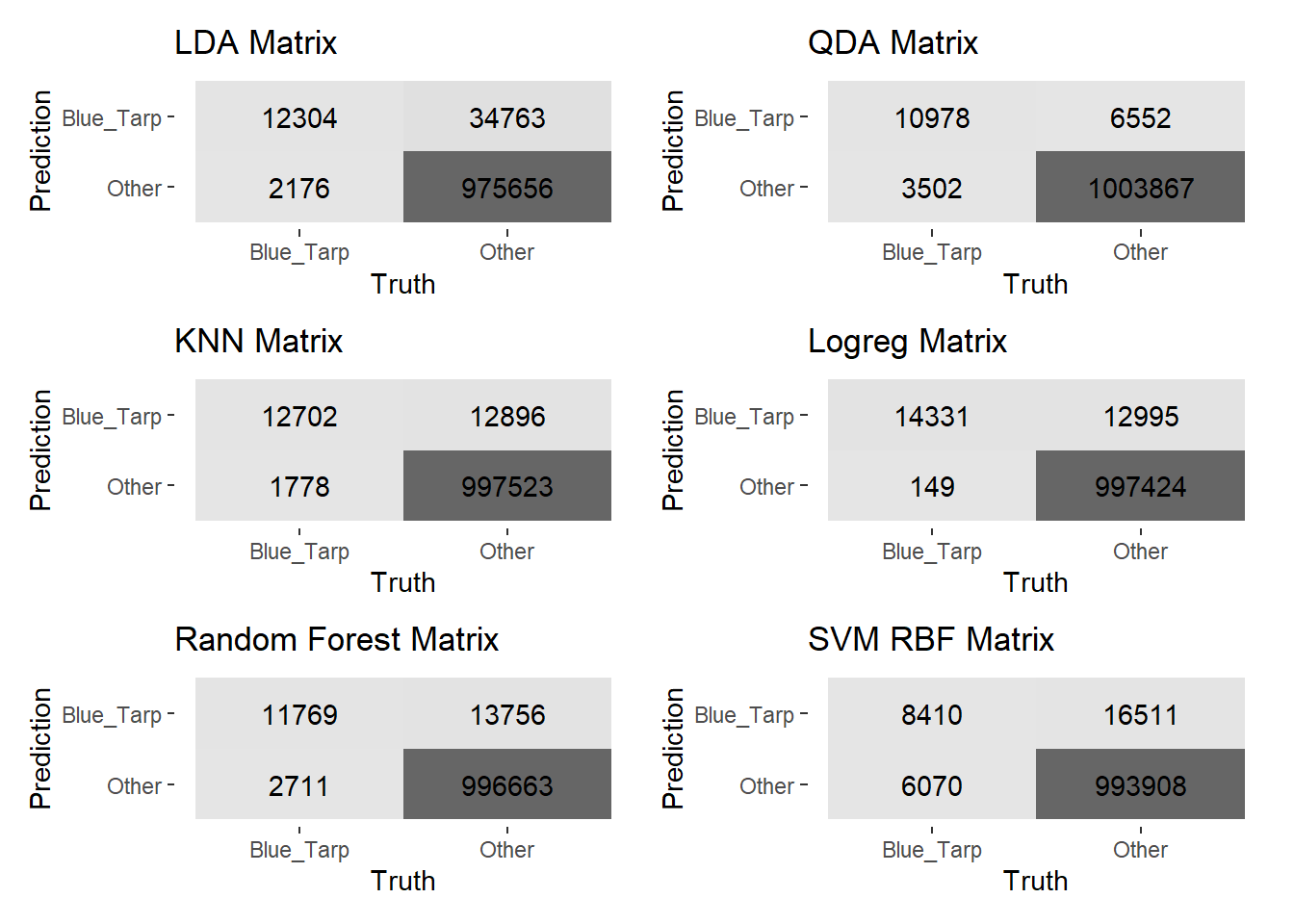
99% recall on blue-tarp detection.When a miss means missing people, recall is the metric that matters.
Where it landed
Penalized logistic regression came out ahead, reaching ninety-nine percent recall on blue-tarp detection. It is a plain reminder that the fanciest model is not always the answer; the right one is the model that optimizes the thing that actually matters for the problem in front of you.