Teaching Myself OCR on Riftbound TCG Cards
AUGUST 28, 2026 · Machine Learning · Computer Vision
OCR, optical character recognition, is software that reads printed words out of a photo, the same trick behind scanning a receipt into searchable text or a phone reading a license plate. It was everywhere at my last job. I used its output constantly and worked around its mistakes, but never built one myself. So for a side project I'd actually enjoy debugging at 11pm, I taught a program to recognize a Riftbound card, the League of Legends trading card game, from a photo, partly by having it read the card's printed name.
Learning OCR by building one
The first decision wasn't the program's brain, it was where to point its eyes. Instead of guessing where the card's name sits, I cropped a bunch of cards and checked: always the same strip, roughly the middle third. Small decision, but it was mine this time, not something already decided before the work reached me.
Then I tuned the OCR tool's own settings, how hard it squints at blurry text, until it read a few more cards correctly without losing the ones it already got. Nothing dramatic. Still the first time I was the one turning the dials instead of filing a ticket.
Then it made everything worse
I combined the OCR text with the program's other method, matching the photo against reference images, expecting two signals to beat one. Instead accuracy on real photos fell from about 93% to about 51%, basically a coin flip.
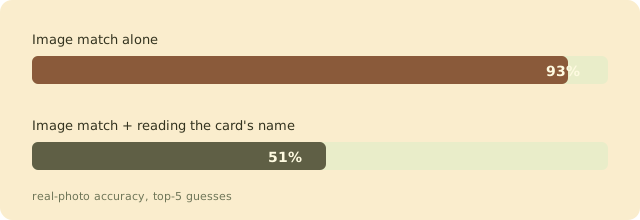
The OCR reads looked fine individually. What was actually happening: a name that looks plausible, confident enough that my code trusts it, still wrong enough to override a correct image match, a mistake a person double-checking the same text would never make. I'd heard this failure described before. Watching it wreck my own numbers is what made it click.
I don't own enough cards
Clean product photos are easy to find online. Real, messy phone photos are not, so I pulled real ones from eBay listings. That fixed coverage but left five to eight real photos per card, too few for the confidence-interval math most people default to, which assumes a decent pile of data. I ended up using the versions built for small samples instead: one for per-card accuracy, one for the overall estimate by resampling what little data I had, one for fairly comparing two model versions on the same photos. Without that, any accuracy number I reported would've been closer to a guess than a measurement.
What's next
More real photos than eBay can give me, ideally cards in my own hand under my own phone camera. The OCR failure still bugs me too. I want to find out if it just needs a stricter trust threshold, or if fusing the two methods was the wrong idea from the start.