Riftbound Classifier
Give it a photo of a physical Riftbound card and it hands back its five best guesses, ranked. The default method needs no training: it turns every reference image into a list of numbers describing what it looks like, does the same to your photo, and returns the closest matches. Two "smarter" versions on top of that, one trained specifically on these cards, one that also reads the card's printed name, both made things worse on real photos. And too few physical cards to build a proper test set meant learning statistics built for small samples instead of my usual defaults.
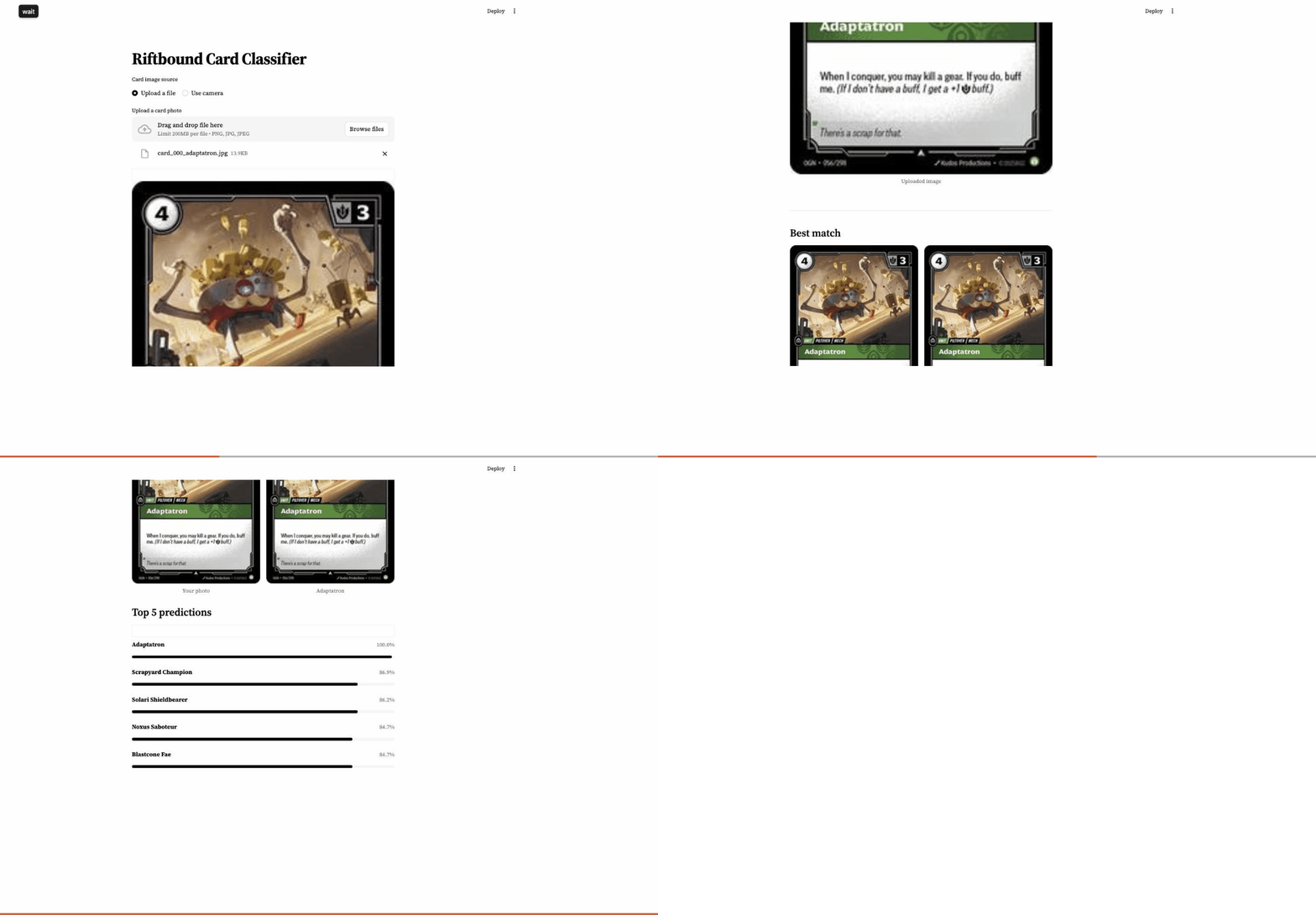
Three ways to guess, and the simple one won
Method one runs every reference image through ResNet18, an image model already trained on millions of unrelated photos, turning each card into a list of numbers and returning whichever reference cards are numerically closest to your photo. No training on Riftbound cards at all. Method two retrains that model's last layer specifically on these 75 cards. Method three keeps method one's guess but blends in a second opinion: OCR reading the printed card name. On real photos, method one got the right card in its top five about 93% of the time. Method two, the one I actually trained, barely beat a coin flip at 6-11% accuracy, two passes over a handful of photos per card isn't enough to learn anything real. Method three, the one I expected to help, dropped to about 51%.
Adding a second opinion dropped real-photo accuracy from ~93% to ~51%.Left in the code anyway, turned off by default, so the failure stays visible instead of disappearing.
Why reading the card's name made things worse
The OCR step wasn't obviously broken on its own, I'd tuned it to catch a few more names without losing the ones it already read fine. The trouble showed up once combined: it would sometimes land on a plausible-looking name, confident enough for my code to trust it, and still wrong enough to outweigh a correct image match, a mistake a person glancing at that crop would never make. Left in the code, off by default, since real phone photos might behave differently than the listing photos I tested on. Better to keep a failed idea visible than bury it.
Not enough cards, so eBay filled the gap
Clean product photos are easy to find at tcgodds.com, but I don't own enough physical cards to build a real-world test set myself. Messy real-life photos came from marketplace and Reddit listings instead, leaving about five to eight per card, too few for the confidence-interval math most people default to. So evaluate.py uses versions built for small samples: one for per-card accuracy, a resampling trick for the overall estimate, and a paired comparison for testing two models on the same photos. test_pipeline.py also checks that no photo used for testing ever leaks into the training set, since that would make every accuracy number meaningless.